
 LORDDARK Team
Stop getting caught on the wrong side of Gold volatility. Learn how to differentiate a high-probability XAUUSD liquidity sweep from a true structural breakout using real-world price action rules.
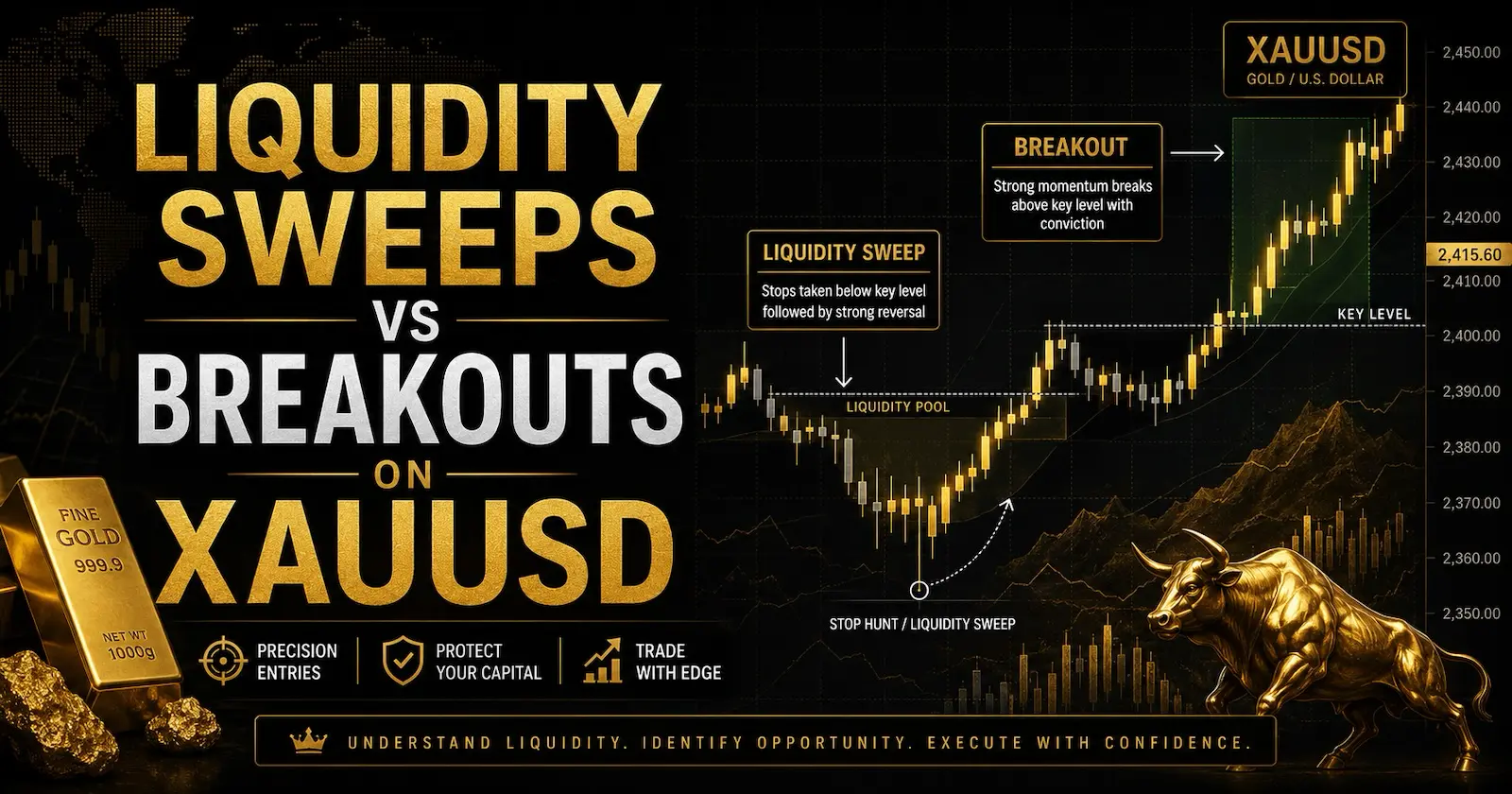
Gold ($XAUUSD$) is notoriously ruthless when it comes to trapping retail traders. Because of its massive daily liquidity and high volatility, what looks like a textbook breakout frequently turns into a violent reversal.
To survive and profit trading Gold, you must master the difference between a Liquidity Sweep (a stop-hunting raid) and a true Structural Breakout.
1. Defining the Market Mechanics
The core difference comes down to intent: is smart money looking to engineer liquidity to fill their own orders, or are they aggressively pushing price into a new value area?
-
Liquidity Sweep: Price briefly pierces a key high or low (Previous Day High/Low, equal highs, or session extremes) solely to trigger resting Stop Losses and pending breakout orders. Once this liquidity is swept, smart money absorbs the orders and violently reverses the price in the opposite direction.
-
Structural Breakout: Price breaks through a key level with strong institutional momentum, closing convincingly beyond it. Instead of reversing, the market accepts these new prices, often retesting the broken level as new support/resistance before continuing the trend.
2. XAUUSD Execution: Side-by-Side Comparison
Before looking at a chart, memorize these distinct structural footprints.
| Feature | Liquidity Sweep (The Fakeout) | Structural Breakout (The Real Move) |
| Candle Closure | Closes inside the range; leaves a long, distinct wick piercing the level. | Closes outside the key level with a full, solid body. |
| Volume & Momentum | Sharp volume spike on the piercing candle, followed by immediate rejection. | Sustained high volume; displacement candles creating Fair Value Gaps ($FVGs$). |
| Order Book Reality | Retails' Stop Losses are triggered; Institutional sell/buy limits are filled. | Major institutional order blocks are breached; new directional flow enters. |
| Timeframe Alignment | Frequently occurs at London/New York Open or high-impact news (CPI, NFP). | Often occurs during sustained volume windows; aligns with HTF trend. |
3. How to Execute: The XAUUSD Blueprint
Trading the Sweep (The Liquidity Grab)
When trading Gold, watch key psychological numbers and session extremes. If price aggressively runs a high (e.g., a known pool of buy-stops) but the lower timeframe ($LTF$, like the 5-minute chart) shows a rapid Market Structure Shift (MSS) downward, you are looking at a sweep.
-
Entry Signal: Wait for the LTF candle to close back inside the range, creating a swing high wick. Enter on the break of the immediate LTF swing low.
-
Stop Loss ($SL$) Logic: Place your SL strictly a few pips above the absolute highest point of the sweep wick.
-
Target ($TP$): Aim for the opposing pool of internal liquidity (the opposite side of the range or an inefficient $FVG$ below).
Trading the Breakout (The Expansion)
If price breaches a level and the M15/M30 candles close entirely outside it with a heavy body, do not chase the market.
-
Entry Signal: Wait for a calm, low-volatility pullback to the broken level (Order Block validation) or the premium/discount array of the breakout leg. Look for a rejection candle to confirm the level flipped from resistance to support.
-
Stop Loss ($SL$) Logic: Invalidated if price closes back deeply inside the original structure. Place your SL below the breakout catalyst candle or the newly formed local swing low.
4. The Trade-Ready Checklist
Before execution, run every potential XAUUSD trade through this filtering system:
-
HTF Context: Is the higher timeframe (H4/D1) in a clear trend or a trading range?
-
Candle Body Check: Did the M15/H1 candle close past the level, or did it just wick through?
-
Session Timing: Are you trading a session open (high fakeout probability) or mid-session expansion?
-
Risk-to-Reward ($R:R$): Is the setup offering at least a 1:2.5 minimum R:R? If the stop is too wide due to gold volatility, skip the trade.
-
News Risk: Are NFP, FOMC, or CPI dropping within the next 30 minutes? If yes, stand down.
💡 Trading Psychology Tip
Gold moves fast enough to trigger immediate FOMO (Fear Of Missing Out). If you miss a breakout, do not chase it at the top. If it's a real breakout, it will present a clean retest. If it doesn't retest, it wasn't your trade to take. Preserve your capital for clear setups.
5. Elevate Your Execution
Mastering the structural nuances between sweeps and breakouts takes time, data, and ruthless self-review. You can have a perfect theoretical understanding of price action, but if you aren't tracking how often you fall for a fakeout versus caught in a true expansion, you are trading blind.
To truly optimize your win rate and map your psychological triggers during high-volatility XAUUSD moves, you need a structured data workflow. Consistently logging your entry triggers, capturing execution screenshots, and calculating your precise metrics via a professional tracking setup like LogTradePro / ProfitDeck bridges the gap between a guessing trader and a disciplined, consistently profitable professional. Treat your data like a business, and the charts will follow.